One of the biggest debates in the blogosphere and political world concerns growth vs. austerity, both for Europe and the United States. Advocates of austerity generally cite a few key points in supporting their perspective. First, deficits and debt are harmful, particularly in the current European context. In order to maintain credibility and be able to continue to borrow in finanical markets, governments must demonstrate that their budget deficits and national debt are under control. If investors perceive that their money is at risk, they will demand higher interest rates before purchasing government bonds. That is why interest rates on Greek bonds are so high, but also why Spanish and Italian long-term government bonds currently have yields of about 6% (compared to less than 1.5% in Germany). Other advocates of austerity present an argument that relies on the view that private spending is more efficient than government spending. While many economists support this perspective overall, some advocates of austerity go so far as to state that significant cuts in government spending can actually lead to more growth in the short run (hard to support from an economic perspective). Others point out the perceived ineffectiveness of the Obama stimulus plan as evidence that spending and/or temporary tax cuts do little to stimulate economic growth.
Most of those who advocate "growth-oriented" policies nowadays seem to advocate increased government spending, though some also propose tax cuts (for example, continuation of the payroll tax cut in the US). They point out that austerity (reduced government spending) hurts the economy in the short run and may even lead to higher budget deficits as economies slow down or slip into recession (resulting in less government tax revenue, etc.). Many of the strongest proponents of "growth" policies (for example, Paul Krugman), think that concern about deficits and debt are overblown and priority should be given to stimulating economic growth, particularly in the United States where yields on government bonds are near record lows.
So who's right? As you can guess, there's some merit to both sides. With regard to austerity, financial markets tend to be the judge since they determine the interest rates that must be paid on bonds. The judge has declared that Greece is guilty and is ready to be sentenced (for example, even after being bailed out again late last year, yields on long-term Greek bonds are almost back to where they were prior to the latest bail out). While Greece may be given the death penalty or life in prison, other countries are also being punished, but less severely (Portugal, Ireland, Italy, and Spain). Thus, they would seem to need to engage in some form of austerity unless they can obtain another source of financing. However, the United States'government is facing record low interest rates, so it has more flexibility and time. If it ignores the warning signs, it will eventual be in a similar situation to countries in Europe, but that's down the road. Implementing a policy of long-term austerity should be sufficient to sway the judge. However, the US hasn't come up with a plan that will be implemented any time soon.
What about growth? Ideally, this is the way to go for countries, but two issues arise - what do you mean by growth and does the country have the flexibility to implement growth-oriented policies? As mentioned above, it's too late for Greece unless Europe is willing to provide large amounts of financing for a long period of time. Let's address the first part of the question - what do you mean by growth? Though spending is the major determinant of short-run economic growth, the type of spending is critical in determining the impact on long-term economic growth. A serious criticism of the Obama stimulus plan is that, though it provided temporary support for demand, it did little to promote sustainable economic growth. For example, though social welfare spending can be supported for other reasons, it does little to promote economic growth over time. Spending that results in real improvements in infrastructure, improves human capital (education & skills), etc., provides support for demand in the short run but also enhances long-term economic growth. Policies that reform social spending while also making productive investments in physical and human capital can reduce deficits while promoting growth over time. Similarly, tax reform that eliminates loopholes (sometimes refered to as tax expenditures) while lowering tax rates can enhance economic growth while containing or reducing budget deficits (depending on how many loopholes are eliminated and how much tax rates are reduced). How does tax reform encourage growth? Basically, getting rid of loopholes (preferences) eliminates special treatment for particular activities while lower tax rates increase the after-tax return on investments and other income-generating activities.
The US still has time to implement policies that reduce the budget deficit over time while encouraging sustainable economic growth (tax reform, entitlement reform, investments in infrastructure and education; of course the details matter). Countries in Europe have less leeway and probably have to give a higher priority towards austerity (or growth-enhancing policies that also lead to lower deficits; for example - eliminate relatively more tax preferences combined with modest reductions in tax rates). Austerity does not lead to more economic growth in the short run while real growth is more than temporary measures whose effects dissipate relatively quickly. Austerity without growth-oriented policies do not address the underlying issues faced by those countries struggling through the European financial crisis. It's not a simple debate between growth vs. austerity. Of course there's a lot more to this story (to be addressed in future posts).
Thursday, May 24, 2012
Friday, May 18, 2012
Greece - exit, stage left?
Will Greece exit the eurozone? There is an increasing probability that it may occur, depending on the results of the upcoming election in June. Rather than consider whether they will leave the eurozone, let's consider what it may look like if they do leave. In some ways, there's no parallel to a country leaving a major currency union such as the eurozone. However, some lessons can be drawn from the Argentine default of 2001 and the experiences of several countries during the Asian financial crisis of 1997-98. What do these 3 sets of countries have in common (Greece, Argentina, developing economies of Asia)? All had fixed exchange rates which were unsustainable. Though there are clearly differences in terms of the economic and financial situations, Argentina and the Asian economies were forced to abandon fixed exchange rates, resulting in extreme depreciations of their currency. The short-term effects were devastating, resulting in severe recessions and high inflation. The second round effects depended in part on the policy response, perceptions of global investors, and the strength of the global economy. Argentina defaulted on its debt and was locked out of the global financial market for years (until it negotiated a deal with many of its debtors). Even today, Argentina pays a high risk premium (high interest rates on its bonds), partly due to its default and partly due to its economic policies. On a more positive note, the significant depreciation of their currencies (Argentina and Asian economies) helped to restore competitiveness, planting the seeds for an economic recovery. The strong global economy of the late 1990s helped many of the emerging economies of Asia rebound. Similarly, the global economic boom helped Argentina recover in the mid-2000s.
What does this mean for Greece? Besides being heavily indebted, the Greek economy is not globally competitive for a variety of reasons. To become competitive, unit costs must be reduced significantly and/or its currency must be devalued. Since it's part of the eurozone, its currency can't decline as much as is necessary. Thus, unit costs must be slashed either through increased productivity or reduced labor costs. Since productivity increases take time (and changes in policy), the focus is on reducing labor costs. When this is combined with the austerity required as part of the bailout packages, it is easy to see why Greece is experiencing a depression (unemplyment over 20%, negative economic growth for the last 4 years, etc.). If Greece left the Eurozone, there would be considerable pain, but unit costs would not need to be reduced as much (competitiveness would be enhanced in part by a cheaper currency instead of lower costs).
So if replacing the euro with the drachma takes the pressure off of reducing unit costs (less need to eliminate jobs and/or cut wages), why not just do it? A bank run is already taking place in Greece as depositors fear that the value of their bank accounts may drop significantly if they are redenominated into drachmas instead of euros. As money leaves Greece and moves to other countries, there's less funds available to finance investment in Greece, reducing both short-term and long-term economic growth. In addition, exchange rate risk will rise (the drachma will be less stable than the euro), leading global investors to require higher interest rates to invest in Greek debt. Of course the default itself will also increase the risk premium of Greek debt. In addition, Argentina and the developing economies of Asia both benefitted from a strong global economy to boost exports. Few economists expect the global economy to grow rapidly any time soon. In particular, Greece's largest trading partners (countries in the EU) are expected to struggle for years to come.
Even though this is a long post, it still only scratches the surface of what a Greek exit from the eurozone would entail. Regardless of whether Greece remains in the eurozone or not, it will need to undertake significant economic reforms to become more competitive and achieve a sustainable recovery. In future posts, we'll examine the debate between austerity vs. growth as well as other issues related to the European debt crisis.
What does this mean for Greece? Besides being heavily indebted, the Greek economy is not globally competitive for a variety of reasons. To become competitive, unit costs must be reduced significantly and/or its currency must be devalued. Since it's part of the eurozone, its currency can't decline as much as is necessary. Thus, unit costs must be slashed either through increased productivity or reduced labor costs. Since productivity increases take time (and changes in policy), the focus is on reducing labor costs. When this is combined with the austerity required as part of the bailout packages, it is easy to see why Greece is experiencing a depression (unemplyment over 20%, negative economic growth for the last 4 years, etc.). If Greece left the Eurozone, there would be considerable pain, but unit costs would not need to be reduced as much (competitiveness would be enhanced in part by a cheaper currency instead of lower costs).
So if replacing the euro with the drachma takes the pressure off of reducing unit costs (less need to eliminate jobs and/or cut wages), why not just do it? A bank run is already taking place in Greece as depositors fear that the value of their bank accounts may drop significantly if they are redenominated into drachmas instead of euros. As money leaves Greece and moves to other countries, there's less funds available to finance investment in Greece, reducing both short-term and long-term economic growth. In addition, exchange rate risk will rise (the drachma will be less stable than the euro), leading global investors to require higher interest rates to invest in Greek debt. Of course the default itself will also increase the risk premium of Greek debt. In addition, Argentina and the developing economies of Asia both benefitted from a strong global economy to boost exports. Few economists expect the global economy to grow rapidly any time soon. In particular, Greece's largest trading partners (countries in the EU) are expected to struggle for years to come.
Even though this is a long post, it still only scratches the surface of what a Greek exit from the eurozone would entail. Regardless of whether Greece remains in the eurozone or not, it will need to undertake significant economic reforms to become more competitive and achieve a sustainable recovery. In future posts, we'll examine the debate between austerity vs. growth as well as other issues related to the European debt crisis.


Saturday, May 5, 2012
April Job Report
April's job report was a disappointment, showing a net increase of 115,000 jobs for the month. In addition, the labor force participation rate dropped to the lowest rate since 1981 as more people dropped out of the labor force. As discussed previously, part of this was likely due to seasonal adjustments that were distorted by the timing of the worst of the recession (seasonal adjustments post-2009 differ significantly from those pre-2009). Basically, seasonal adjustments are based on the historical pattern of hirings/layoffs by month. For example, in a normal January, employment at retailers declines as those hired for Christmas lose their jobs. The steepest job losses of the recession took place in the January-February 2009, so using those months to estimate seasonal patterns would imply larger than usual layoffs in January and February. When January and February data are seasonally adjusted in the future (following 2009), more jobs are included to reflect the new seasonal pattern. In other words, some of the layoffs due to the recession end up being attributed to seasonal factors. This led to seasonal data overestimating job growth in January-February 2011 and 2012. Given that seasonally adjusted employment was overestimated early in the year, growth in subsequent months would be undestimated. Since I raised this issue back in February, it's clear that this is not just an excuse to explain away the most recent reports about the job market. In addition to seasonal adjustment issues, the warmer than usual weather had an effect as well. In addition, as noted previously, the relatively strong employment gains earlier this year were hard to justify given the modest economic growth.
On to the details of this month's report. A relatively high portion of the jobs being created continue to be in relatively low-paying sectors of the economy as accomodation and food services added nearly 27,000 jobs while temp agenices added 21,000 jobs (over 40% of net new job creation). The index of aggregate hours worked has been flat over the last 2 months, suggesting that economic growth for the second quarter has gotten off to a weak start. The labor force participation rate for all adults is now the lowest since 1981. For adult men (20 and older), it's now the lowest on record (records started being kept in 1948) while for adult women, it's the lowest since 1995. Economist keep waiting for discouraged workers to re-enter the job market, but instead more people keeping dropping out. Part of it is due to aging of baby boomers, but part is due to economic weakness and may lead to structural problems as the skills of these potential workers continue to deteriorate.
How bad is the news? Not as bad as it sounds (perhaps due to low expectations!). The economy continues to grow modestly and jobs are being added, but the job gains reported earlier this year are now generally accepted to have been misleadingly high as the economy still continues to struggle to recover from a historic financial crisis.
On to the details of this month's report. A relatively high portion of the jobs being created continue to be in relatively low-paying sectors of the economy as accomodation and food services added nearly 27,000 jobs while temp agenices added 21,000 jobs (over 40% of net new job creation). The index of aggregate hours worked has been flat over the last 2 months, suggesting that economic growth for the second quarter has gotten off to a weak start. The labor force participation rate for all adults is now the lowest since 1981. For adult men (20 and older), it's now the lowest on record (records started being kept in 1948) while for adult women, it's the lowest since 1995. Economist keep waiting for discouraged workers to re-enter the job market, but instead more people keeping dropping out. Part of it is due to aging of baby boomers, but part is due to economic weakness and may lead to structural problems as the skills of these potential workers continue to deteriorate.
How bad is the news? Not as bad as it sounds (perhaps due to low expectations!). The economy continues to grow modestly and jobs are being added, but the job gains reported earlier this year are now generally accepted to have been misleadingly high as the economy still continues to struggle to recover from a historic financial crisis.
Tuesday, May 1, 2012
GDP and the Income/Spending Report
It's time to catch up on recent reports about the economy. Last Friday's GDP report was somewhat surprising, given the composition of economic growth. While consumption rose moderately (somewhat high by current standards), business investment actually declined. This was likely due to policy issues as some companies moved investment into the fourth quarter of 2011 to take advantage of expiring tax breaks. But even with that, investment growth over the last 2 quarters was lower than any time since the Winter of 2009-10. Investment in equipment grew at an annualized rate of 4.5% over the last 6 months compared to nearly 11% in the previous 6 months. After surging in the Spring and Summer of 2011, investment in structures has declined by about 6.5% in the Fall and Winter (seasonally adjusted, annualized rate). Together, this suggests that the bounceback in investment following the end of the recession is over and firms are now basing their investment decisions on expected economic conditions.
Meanwhile, though consumption was a strong point in the GDP report, the income/spending report released on Monday indicates that consumer spending was slowing down as the first quarter came to an end. After increasing at an annualized rate of nearly 5% in January and February, growth in real consumer spending slowed to just over a 1% rate in March. At the same time, real disposable income was flat for the quarter, resulting in a lower savings rate (i.e., more spending with flat income results in less savings). This implies that unless income starts to increases more quickly, consumer spending should slow down in the coming months.
Given a slowdown in investment growth and slower, but moderate growth in consumer spending, economic growth should remain moderate through the rest of 2012 (barring some external shock, such as from Spain). As discussed elsewhere, moderate economic growth means that employment growth should also moderate, as already seen in the March employment report. This doesn't mean that the economy is going to worsen, but that it should continue to grow at a modest pace.
Meanwhile, though consumption was a strong point in the GDP report, the income/spending report released on Monday indicates that consumer spending was slowing down as the first quarter came to an end. After increasing at an annualized rate of nearly 5% in January and February, growth in real consumer spending slowed to just over a 1% rate in March. At the same time, real disposable income was flat for the quarter, resulting in a lower savings rate (i.e., more spending with flat income results in less savings). This implies that unless income starts to increases more quickly, consumer spending should slow down in the coming months.
Given a slowdown in investment growth and slower, but moderate growth in consumer spending, economic growth should remain moderate through the rest of 2012 (barring some external shock, such as from Spain). As discussed elsewhere, moderate economic growth means that employment growth should also moderate, as already seen in the March employment report. This doesn't mean that the economy is going to worsen, but that it should continue to grow at a modest pace.
Friday, April 20, 2012
By special request, here's a discussion of monetary policy and the economy. For the last several years, some have warned that inflation will spin out of control because of QE1, QE2, and other forms of stimulus implemented by the Fed. The basis for their argument is that the money supply is growing too rapidly and too much money is chasing too few goods, which results in high inflation. So why hasn't inflation risen much above 3% in recent years? One reason is that some are confusing the monetary base (which consists of bank reserves and cash in circulation) with the money supply (bank deposits and cash circulation). The monetary base has experienced explosive growth since 2008, but the money supply hasn't grown nearly as much. Since the collapse of Lehman Brothers in mid-Septmber, 2008, the monetary base has grown at an annual rate of 37%, but the money supply has only grown by 4.5% per year (though that has risen recently). Why? Because banks are holding onto a record amount of excess reserves (S1.5 trillion as of April 18, 2012). Next, is there a chase taking place? Going back to Irving Fisher, economists have made use of the equation of exchange to estimate this chase by multiplying the money supply (M) by the velocity of money (V). How has this behaved over time? The chart below estimates the chase by considering the percentage change in MV:
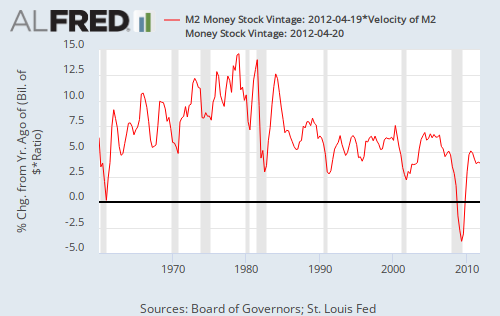
You'll note that it grew rapidly in the 1970s, resulting in inflation (as expected). However, it dropped significantly during the recession and is still growing only modestly, thus suggesting that inflation is not a threat at this time.
What happens when banks start lending those excess reserves? Excess reserves declined by $100 billion in the second half of 2011, but have since stabilized. If banks start loaning large amount of excess reserves, the money supply will begin to expand rapidly and inflation becomes a threat. That's why it's critical for the Fed to have an exit strategy (which Ben Bernanke has explained on repeated occasions; for example, click here). Having a strategy and executing it well is easier said than done. In the mid-2000s, the Japanese central bank implemented QE and then withdrew it without igniting inflation, so it can be done. On the flip side, how likely is QE3? Bernanke has stressed that the primary rational for QE1, QE2, and a possible QE3 is to avoid deflation. A sluggish recovery with moderate inflation doesn't justify QE3. Barring another perceived (or actual) threat of deflation, QE3 would seem to be unlikely.
What's happening with bank lending? Here's a table that traces bank lending in its many forms. Commercial and industrial loans rebounded nicely in 2011, but real estate and consumer loans continue to languish.
The principles of monetary policy that existed prior to the Great Recession still appear to hold true. Given that the money supply is not expanding at a rapid rate by historical standards and given that there's no chase, inflation is not a threat in the near term. If conditions change and the Fed sits idly by, inflation could be an issue down the road, but this is unlikely to occur. Executing the exit strategy will be difficult (too soon could stifle the recovery, too late could lead to higher inflation than desired), but chances are the mistake is likely to be relatively small, making high inflaiton unlikely. On a related not, break-even inflation according to the TIPS market is 1.91% over the next 5 years and 2.19% over the next decade, suggesting that financial markets are not concerned about inflation any time soon.
You'll note that it grew rapidly in the 1970s, resulting in inflation (as expected). However, it dropped significantly during the recession and is still growing only modestly, thus suggesting that inflation is not a threat at this time.
What happens when banks start lending those excess reserves? Excess reserves declined by $100 billion in the second half of 2011, but have since stabilized. If banks start loaning large amount of excess reserves, the money supply will begin to expand rapidly and inflation becomes a threat. That's why it's critical for the Fed to have an exit strategy (which Ben Bernanke has explained on repeated occasions; for example, click here). Having a strategy and executing it well is easier said than done. In the mid-2000s, the Japanese central bank implemented QE and then withdrew it without igniting inflation, so it can be done. On the flip side, how likely is QE3? Bernanke has stressed that the primary rational for QE1, QE2, and a possible QE3 is to avoid deflation. A sluggish recovery with moderate inflation doesn't justify QE3. Barring another perceived (or actual) threat of deflation, QE3 would seem to be unlikely.
What's happening with bank lending? Here's a table that traces bank lending in its many forms. Commercial and industrial loans rebounded nicely in 2011, but real estate and consumer loans continue to languish.
The principles of monetary policy that existed prior to the Great Recession still appear to hold true. Given that the money supply is not expanding at a rapid rate by historical standards and given that there's no chase, inflation is not a threat in the near term. If conditions change and the Fed sits idly by, inflation could be an issue down the road, but this is unlikely to occur. Executing the exit strategy will be difficult (too soon could stifle the recovery, too late could lead to higher inflation than desired), but chances are the mistake is likely to be relatively small, making high inflaiton unlikely. On a related not, break-even inflation according to the TIPS market is 1.91% over the next 5 years and 2.19% over the next decade, suggesting that financial markets are not concerned about inflation any time soon.
Friday, April 6, 2012
March Employment Report
In recent posts, I've noted how the data has presented a mixed message about the economy with the job market indicating a strengthening economy while GDP and other data indicating a more sluggish economy. Today's job market report suggests that previous job market reports were biased upward, probably due to seasonal adjustments and extra warm weather. The report indicated that 120,000 jobs were created in March, down considerably from over 200,000 per month in recent months. In addition, the unemployment rate declined to 8.2%, but this was due to more people leaving the labor force as the household survey (used to estimate the unemployment rate) showed a loss in jobs. A more precise measure of the labor market is hours worked, which declined in March, led by declines in construction and manufacturing.
What sectors led to the relative weakness in the job market? Temp agencies added 55,000 jobs in February, but lost 7500 in March (a difference of 62,500, which accounts for a majority of the decline). The rest of the weakness appears to be spread throughout other sectors, with slowdowns particularly evident in health care and information services.
Are there any positive news from the report? Besides the decline in the unemployment rate, the broad measure of unemployment (U6) declined from 14.9% to 14.5% This was mainly due to a decline in those working part-time for economic reasons. As part-time employment fell, more people were working full time.
Rather than reflecting a significant slowdown in the job market, I think the report indicates limitations in the data, due to seasonal adjustments and unusually warm weather in many parts of the country. As noted elsewhere, it's going to be hard for the job market to improve significantly unless economic growth also strengthens, which is not expected in the near future.
What sectors led to the relative weakness in the job market? Temp agencies added 55,000 jobs in February, but lost 7500 in March (a difference of 62,500, which accounts for a majority of the decline). The rest of the weakness appears to be spread throughout other sectors, with slowdowns particularly evident in health care and information services.
Are there any positive news from the report? Besides the decline in the unemployment rate, the broad measure of unemployment (U6) declined from 14.9% to 14.5% This was mainly due to a decline in those working part-time for economic reasons. As part-time employment fell, more people were working full time.
Rather than reflecting a significant slowdown in the job market, I think the report indicates limitations in the data, due to seasonal adjustments and unusually warm weather in many parts of the country. As noted elsewhere, it's going to be hard for the job market to improve significantly unless economic growth also strengthens, which is not expected in the near future.
Sunday, April 1, 2012
Spending vs. Income
One of the reasons that many economists remain cautious about the ongoing strength of the recovery is the state of the consumer. Two factors are expected to constrain consumer spending - deleveraging and modest gains in income. On Friday, the government released the latest report on disposable income and consumer spending. The headline numbers show that though disposable income rose by 0.2% in February, consumer spending rose by 0.8%, reducing the savings rate to 3.7%, the lowest since August 2009. After adjusting for inflation, real disposable income actually declined slightly while spending rose by 0.5% (real disposable income has declined in 3 out of the last 4 months). For all of 2011, real disposable income rose by 1.3% while spending rose by 2.2%. The blog, Calculated Risk, has a brief discussion of the role of transfer payments in affecting personal income (note: transfer payments include government payments such as social security, welfare, etc.). Real disposable income excluding transfer payments are still down 4.2% since the start of the recession.
It's hard to imagine consumer spending increasing at a high and sustained pace unless there's more significant gains in income. The hope is that recent gains in employment will translate into income gains, but it's not showing up yet. Thus, it's likely that growth in consumer spending is likely to be more subdued as 2012 progresses, thus limiting the pace of economic growth (note: it still signals continued economic growth).
It's hard to imagine consumer spending increasing at a high and sustained pace unless there's more significant gains in income. The hope is that recent gains in employment will translate into income gains, but it's not showing up yet. Thus, it's likely that growth in consumer spending is likely to be more subdued as 2012 progresses, thus limiting the pace of economic growth (note: it still signals continued economic growth).
Subscribe to:
Posts (Atom)